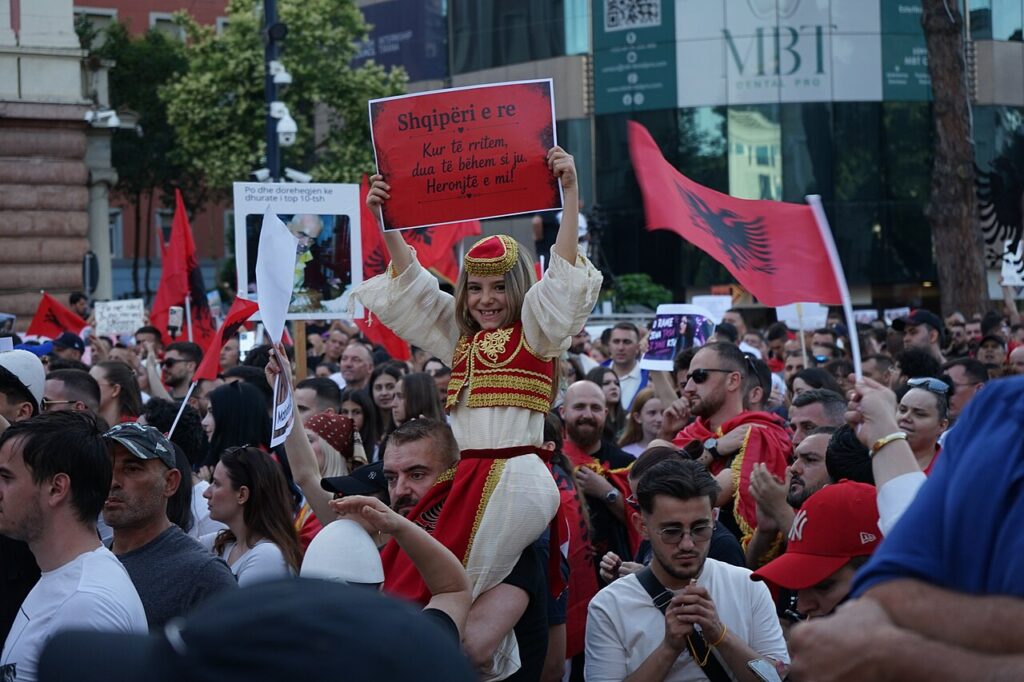
Police in Albania fired rubber bullets at anti-government protesters in the capital, Tirana, on Saturday — the first time the weapon has been used since five days of unrest began, in an escalation that has also seen seven officers suspended and the Israeli embassy temporarily shut its doors.
Thousands of young Albanians, most of them students, gathered outside the Education Ministry in central Tirana on the fifth consecutive day of demonstrations demanding the resignation of Prime Minister Edi Rama. The confrontation turned when a group of masked youths hurled rocks at riot police, who answered with stun grenades, tear gas and a water cannon.
Then, according to Reuters video footage, an officer fired what appeared to be a shotgun toward the crowd. Reuters reporters found rubber pellets scattered on the pavement. The pellets struck two Reuters journalists and several protesters, leaving round welts.
National police chief Skender Hita did not deny the use of rubber bullets when asked about it at a news conference on Saturday. “All means that were used were employed in a limited manner, including the most recent ones,” he said. He also announced that seven officers had been suspended and faced disciplinary investigations for “exceeding their authority” and “failure to respect the principle of proportionality” — without saying which incidents triggered the suspensions.
The numbers sketch a week spiraling out of control. Hita said 167 people had been arrested over the five days of unrest, and 132 police officers injured. The Health Ministry said nine protesters and four police officers received medical treatment on Saturday alone. An earlier police tally put 500 protesters detained in total — 330 of them since released — with 120 officers and 45 protesters officially registered as injured, though officials acknowledge many protester injuries likely went unrecorded. The escalation follows a fourth day of clashes that left 156 injured, after which Rama blamed “foreign hands” for the unrest.
Rama toured businesses damaged in the unrest on Saturday. He promised to listen to the students and protect their right to demonstrate, while warning against further destruction — and accused his conservative political opponents of encouraging the violence. Rama, a former basketball player whose centre-left Socialist Party has governed this Balkan nation of about 2.8 million people since 2013, won a fourth term in elections last year and told Reuters this week he would not step down. “Governments are changed through democratic elections and we had them last year, not through violence,” he said.
The most striking figure on the streets may be Marjana Koceku, 25. Last year Rama hand-picked her to run for Albania’s parliament as a fresh young face of his party. This week she stood among the protesters as an independent member of parliament, demanding he go. “The country is amazing, but … the wrong policies that have been implemented by this political elite are completely against what the Albanian communities and Albanian citizens have been asking and seeking for so long,” she said, as police fired tear gas and water cannon nearby. “It’s been 13 years of corruption and 13 years of doing nothing and empty promises. So the jar is filled and we are here for our rights,” said Juri Taullahu, a 22-year-old medical student.
What began as a student grievance — corruption, a lack of jobs, poor education standards — has fused with anger left over from a summer of largely peaceful protest against a luxury coastal resort planned for Albania’s pristine southern shoreline, backed by investors including US President Donald Trump’s son-in-law, Jared Kushner. Reuters found no evidence of wrongdoing by Kushner, who is not directly involved in the villagers’ land dispute, but the project has become a lightning rod. The student movement, known as the “Flamingo” movement, now draws support from people who felt ignored during the summer demonstrations.
Israel’s embassy in Tirana announced its temporary closure on Friday, saying the resumption of operations would “be considered in accordance with events.” The protests echo a wider wave of youth activism in Europe: in France, high school students have spent weeks blockading schools and marching alongside workers — a movement that drew 550,000 to the streets on Saturday.
Rubber bullets mark a threshold. Albania is an EU candidate country, and images of police firing projectiles at students — including foreign journalists — cut against the democratic standards Brussels demands of aspiring members. For a movement led by people who have known no other prime minister, the resignation demand is about 13 years of accumulated frustration as much as any single scandal. Whether Rama’s combination of concession and crackdown turns the fifth day into a footnote or hardens it into a revolt will be decided on the streets of Tirana this week — and the outcome will be read across the Balkans as a test of whether Europe’s new youth movements can topple entrenched governments.