Informopedia Explains: The same storm can have three different names, and the name it gets depends entirely on where it shows up. A storm that forms over the Atlantic and slams into Florida is a hurricane. The identical storm, forming over the western Pacific and hitting Japan, is a typhoon. Over the Indian Ocean or near Australia, it is a cyclone. The physics is the same. The map is different.
That is the short answer. The longer answer explains why the most powerful storms on Earth need warm water, a spinning planet and a name — and why the naming matters more than it looks.
One storm, three names
Meteorologists use one umbrella term: tropical cyclone. It describes a rotating system of clouds and thunderstorms, organised around a centre of low pressure, that forms over warm tropical or subtropical ocean water. When its sustained winds reach 74 miles per hour (119 kilometres per hour), it earns its regional name:
- Hurricane — in the North Atlantic, the Caribbean, the Gulf of Mexico, and the central and eastern North Pacific. The word comes from Huracán, a Caribbean god of evil.
- Typhoon — in the northwestern Pacific, near East and Southeast Asia. Typhoons can grow stronger than hurricanes because they form over warmer water and have more open ocean to cross.
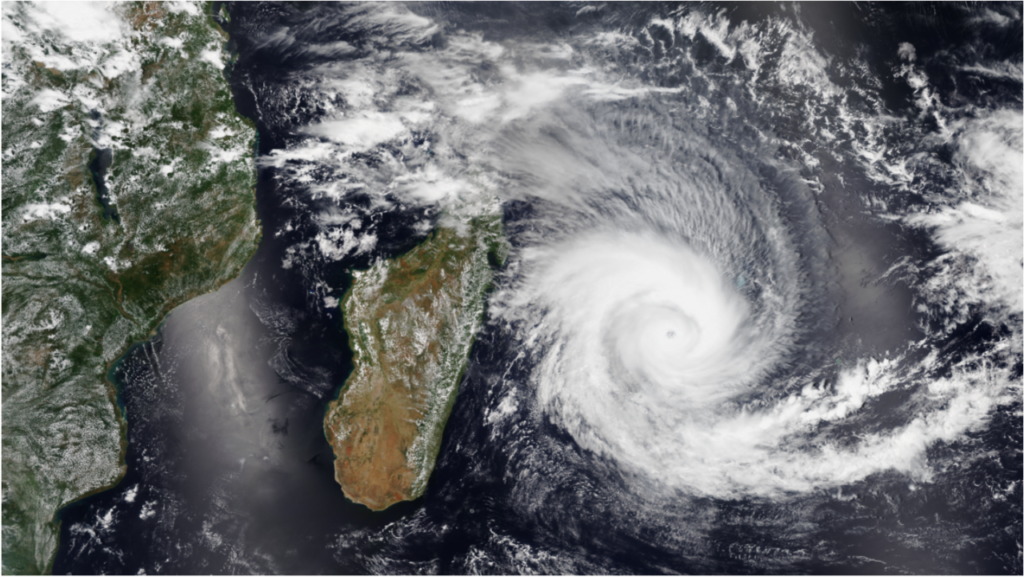
- Cyclone — in the South Pacific and the Indian Ocean, including around Australia, India and Madagascar.
A storm that crosses from one ocean basin into another can change its name mid-journey. The storm itself does not care; the name is a label for the people in its path.
How a tropical cyclone is born
It starts with heat. The ocean surface must be at least 26.5°C (about 80°F) — warm enough to feed the storm. Warm, moist air rises from the surface, creating an area of low pressure below. Air from surrounding areas rushes in to fill it, rises in turn, cools, and condenses into towering thunderclouds. The heat released by that condensation warms the air further, which makes it rise faster, which pulls in more air. The system feeds on itself like an engine, and the ocean is the fuel.
Then the Earth’s rotation gives it a spin. The Coriolis effect — the deflection caused by the planet turning beneath the moving air — bends the incoming air into a spiral: counterclockwise in the Northern Hemisphere, clockwise in the Southern. Near the equator, the Coriolis effect is too weak to start the spin, which is why tropical cyclones almost never form within about five degrees of latitude of the equator.
As the storm strengthens, it passes through stages. Winds below 39 mph make it a tropical depression. Between 39 and 73 mph, it is a tropical storm — and it gets a name. At 74 mph and above, it becomes a hurricane, typhoon or cyclone, and an eye forms at its centre: a calm, clear hole where air sinks instead of rising, surrounded by the eyewall, the ring of the most violent winds and heaviest rain.
How we measure the danger
In the Atlantic and eastern Pacific, hurricanes are rated on the Saffir–Simpson scale, from Category 1 (74–95 mph winds) to Category 5 (157 mph and above). The scale measures wind speed only — it says nothing about rainfall, storm surge or the size of the storm, which is why a “mere” Category 1 can kill more people through flooding than a Category 5 that hits a sparsely populated coast. Hurricane Isaias, a Category 3 storm, left two people dead and 800,000 without power when it came ashore in Florida last month; the remnants of Hurricane Simon and Storm Rachel killed six people in flooding on Mexico’s Pacific coast. In both cases, water — not wind — did most of the damage.
Other regions use their own scales. The World Meteorological Organization classifies typhoons from strong to violent, and Australia rates cyclones from Category 1 to 5 on a different scale. The numbers are not directly comparable, which is one reason the same storm can sound more or less dangerous depending on which country’s bulletin you read.
Why the name matters
It matters because warnings save lives only if people understand them. A resident of Miami knows what a hurricane warning means; a resident of Manila knows what a typhoon warning means. The regional names are a shared language between forecasters and the people in the storm’s path — and in a world where a warming ocean is giving these storms more fuel, that shared language is becoming more important, not less. The storm does not care what you call it. The people in its way do.