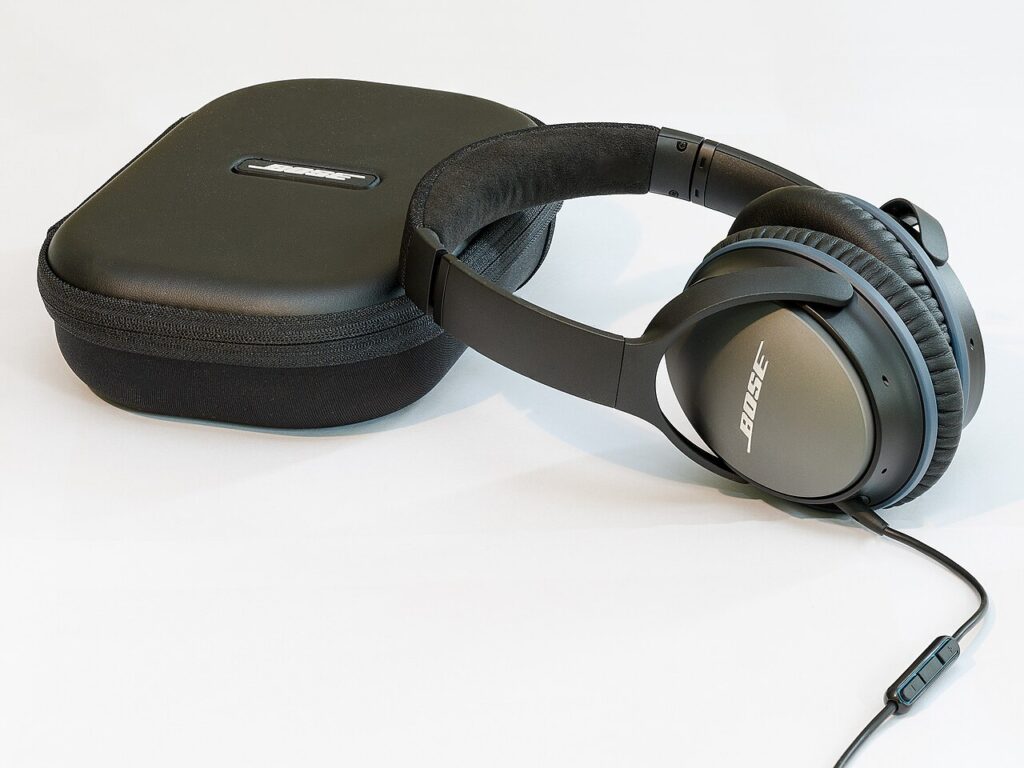
Informopedia Explains: Put on a pair of noise-cancelling headphones in a plane cabin and something strange happens. The engine drone — that low, relentless roar that has filled the cabin since takeoff — simply disappears. Not muffled. Gone. And yet the headphones are not blocking the sound. They are making more of it.
That is the trick at the heart of active noise cancellation, and it is one of the neatest pieces of physics you can buy for the price of a pair of headphones. The headphones listen to the noise around you, flip it upside down, and play the flipped version into your ears at exactly the right moment. The two sounds collide and cancel each other out. Silence, manufactured in real time.
Sound is a wave — and waves can cancel
Sound travels as a pressure wave: air molecules squeezed together, then stretched apart, over and over. Picture a wave on the sea, with peaks and troughs. Now imagine a second wave, identical but upside down — its peaks lining up with the first wave’s troughs, and its troughs with the first wave’s peaks. Add them together and you get nothing. Flat water. That is destructive interference, and it is the whole idea behind noise cancellation.
Inside the headphones, tiny microphones — called reference microphones — sit on the outside of the earcups and constantly sample the noise around you. A digital signal processor analyses those samples and computes an inverted copy of the sound wave, flipped 180 degrees out of phase. The headphone’s speaker plays that inverted wave — the “anti-noise” — into your ear at the same moment the real noise arrives. Peak meets trough, trough meets peak, and the pressure changes cancel out before they reach your eardrum.
The idea is older than the technology. In 1936, the German physicist Paul Lueg patented a theoretical system for cancelling sound by inverting its waveform. It took half a century of electronics to make it practical: the anti-noise has to be generated in a fraction of a millisecond, because if it arrives even slightly late, it adds to the noise instead of cancelling it.
Feedforward, feedback, hybrid
Modern headphones use one of three microphone layouts, and the difference matters for how well they work.
Feedforward systems place the microphone on the outside of the earcup, listening to the noise before it reaches your ear. They react fast, but they cannot hear what actually got through, so they can miss their target. Feedback systems place the microphone inside the earcup, measuring the sound that reaches the listener — including the anti-noise — and correcting the output. They are more accurate but slower, and they can struggle with sudden sounds. Most premium headphones today use a hybrid system: microphones both outside and inside, combining the speed of feedforward with the accuracy of feedback.
All three designs share a weakness. Cancellation works best on low, steady, predictable sounds — engine drone, air-conditioning hum, the rumble of a train — because their long wavelengths give the processor time to build an accurate inverted copy. Short, sharp, unpredictable sounds — a voice, a breaking glass, a baby crying — change too fast. The processor cannot predict them, and the headphones can only muffle them with the physical padding of the earcups. That is why your colleague’s voice still cuts through, and why the headphones are marketed for travel, not for silence.
Why the seal matters too
Active cancellation is only half the story. The other half is passive isolation: the ear cushions or in-ear tips that physically block sound before the electronics get involved. A good seal does most of the work against high frequencies; the electronics do most of the work against low ones. Together they are far more effective than either alone — which is why a pair of noise-cancelling headphones with a poor fit sounds noticeably worse, and why in-ear models live or die by the size of the silicone tip.
There is one more catch. The anti-noise is generated locally, at your ear. It does not make the room quieter; it changes the sound pressure at one precise point — your eardrum. Step outside the headphones and the noise is still there, unchanged. The silence is personal, engineered, and a fraction of a second old.
Why this matters
Noise cancellation began as aviation equipment — pilots needed to hear radio calls over engine roar — and it is still, at its core, a safety technology that escaped into consumer electronics. Today it is in earbuds, car cabins and office headsets, and the same principle is being tested in windows, car exhausts and even open-plan offices. The idea is simple enough to state in a sentence and hard enough to execute that it took decades to miniaturise. The next time the cabin drone vanishes, remember: nothing was blocked. Something was added — an exact mirror of the noise, played so precisely that the two sounds erased each other. It is the closest thing to silence you can buy.
Like the satellite signals that let your phone know where you are — a system that needs Einstein’s relativity to work at all — noise cancellation is one of those everyday technologies that hides a surprising amount of physics inside a small piece of plastic. And like the 1,000 satellites Amazon has now put in orbit, it is a reminder that the most interesting engineering is often the kind you never see.