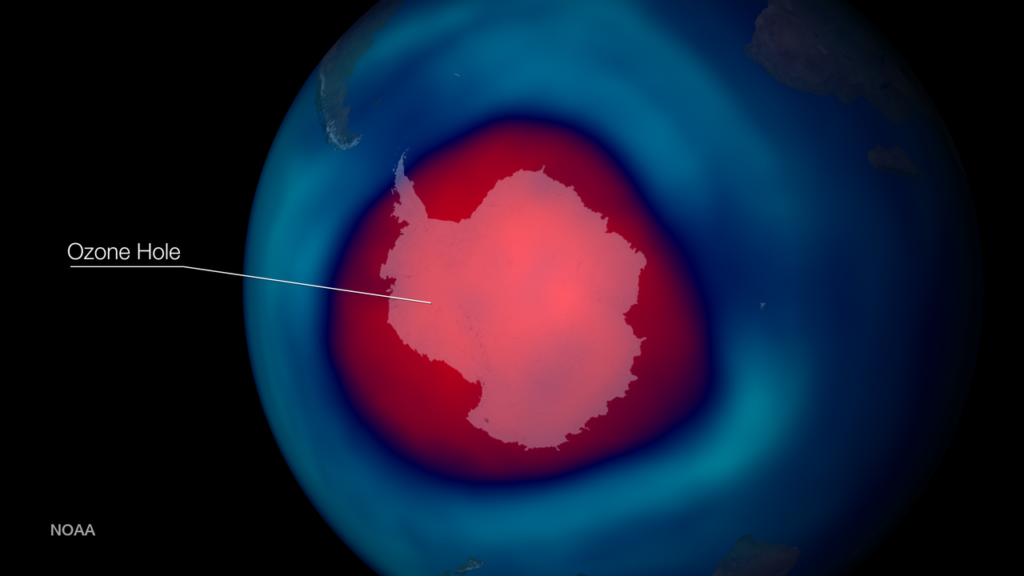
Informopedia Explains: In the first week of November, NASA and the US National Oceanic and Atmospheric Administration delivered a headline that sounded like bad news from a problem the world thought it had solved. The hole in the ozone layer over Antarctica grew this year to the seventh-largest size in 48 years of monitoring — 25 million square kilometres on average during the peak season, more than twice the area of the United States, and 27.1 million square kilometres at its largest, on 18 September. It was the biggest ozone hole in a decade.
And yet the scientists delivering the news were calm. “The ozone layer remains on track for long-term recovery,” NASA said. Both things are true at once. To understand how, you have to understand what the ozone hole actually is — and why its size in any given year is as much about the weather as about chemistry.
What the ozone layer does
Ozone is a form of oxygen — three oxygen atoms bound together instead of the usual two — that sits in a thin band 15 to 30 kilometres above the Earth. It is invisible, and there is not much of it: if you compressed all the ozone in the atmosphere down to sea-level pressure, it would form a layer about 3 millimetres thick. But that wafer of gas absorbs most of the Sun’s ultraviolet-B radiation, the kind that causes skin cancer, cataracts and damage to crops and marine plankton. Without it, life on land as we know it would not exist.
The “hole” is not a literal hole. Scientists define it as the region over Antarctica where ozone falls below 220 Dobson units — a measure of how much ozone sits in a column of air. Every southern winter, a vortex of powerful winds forms around Antarctica, trapping extremely cold air over the continent. Inside that vortex, clouds made of ice crystals form in the stratosphere, and on their surfaces, chlorine and bromine compounds — leftovers of the chlorofluorocarbons (CFCs) once used in fridges, spray cans and air conditioners — wake up and start destroying ozone. When spring sunlight returns in September, the destruction accelerates. By October the hole is at its worst; by December, as the vortex breaks up, it heals.
Why 2026 was so big
This year’s hole was large because the weather cooperated with the chemistry. The polar vortex was unusually powerful and long-lived, partly because the giant planetary-scale waves that normally weaken it were especially feeble in August and September, according to NOAA research scientist Amy Butler. A stronger vortex means a larger area of air cold enough for the destructive clouds to form — and more room for the hole to grow.
That is also why the hole was large but not deep. Balloon measurements from the South Pole found ozone directly overhead fell to 105 Dobson units on 17 October — low, but well above the record low of 92, measured in October 2006. The hole was wide, not ferocious. And here is the key number: NASA estimates the 2026 hole would have been 1 to 2 million square miles larger — up to 3.5 million square kilometres — if ozone-destroying chemicals were still as common in the atmosphere as they were at their peak in 2000.
The treaty that actually worked
That is the legacy of the Montreal Protocol, signed in 1987, when the world agreed to phase out CFCs and other ozone-depleting substances. It is the most successful environmental treaty ever negotiated: every country on Earth ratified it, the chemicals were replaced, and atmospheric chlorine has been falling for years. NASA’s ozone research team leader, Paul Newman, noted that the annual hole has been forming later in recent years — a quiet sign of recovery.
Scientists expect the Antarctic ozone hole to heal by the 2070s, as the old chemicals slowly break down. But the path will not be smooth. Big holes will keep appearing in years when the vortex is strong, and the hole’s size in any single year says more about that year’s weather than about the long-term trend. The 2025 hole, by contrast, was the fifth smallest since 1992. The lesson of 2026 is not that the treaty failed. It is that recovery is real but noisy — and that a single bad year is a weather report, not a verdict.
Why this matters
The ozone story is the rare environmental success that proves international cooperation can work — and a warning about how slowly the atmosphere forgives. The chemicals banned in 1987 will linger for decades; the hole will keep opening every spring for another generation. But the trajectory is now set by policy, not by accident. If the world wants the same result for the climate, the ozone hole offers the blueprint: a clear scientific consensus, a binding treaty, and the patience to let the numbers move over decades rather than news cycles. The climate adaptation gap shows how far that patience is still being tested — and the record-breaking El Niño shows what happens when the weather turns hostile before the policy catches up.
Source: NASA, “NASA, NOAA Track 2026 Antarctic Ozone Hole”, 4 November 2026