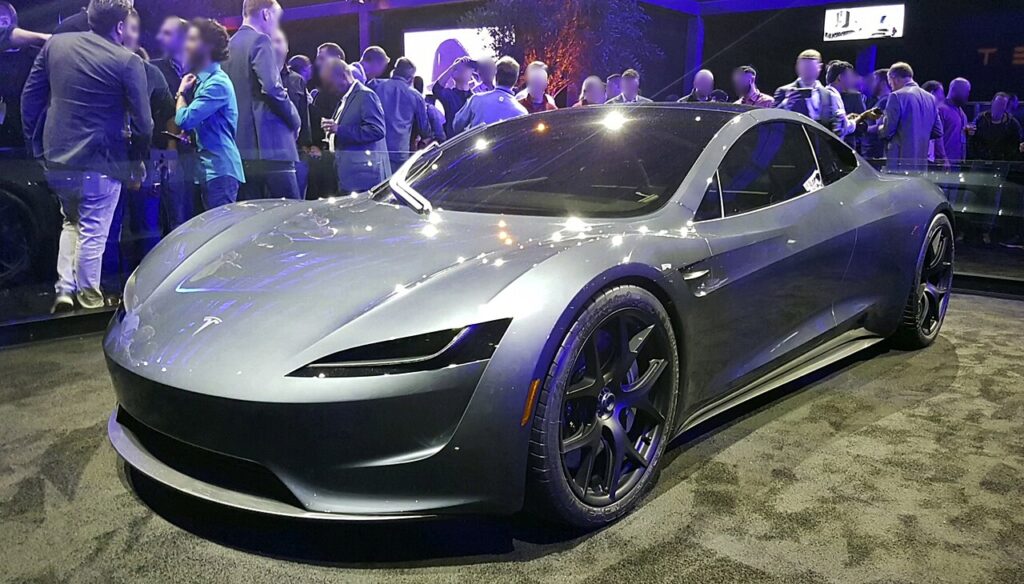
Elon Musk unveiled a Tesla Roadster that he says can fly — and then had it drive upside down on a curved ramp, launch into the air, flip, and land. The demonstration, staged outdoors at SpaceX’s rocket test site in McGregor, Texas, on Thursday evening, is the most theatrical product reveal of Musk’s career: a sports car that behaves like a stunt plane, built with rocket-company hardware.
The Roadster rolled up a steep curved ramp and kept going, driving inverted along it — held to the surface, Musk explained, by suction fans generating more than 2 Gs of cornering grip. Then it launched off the ramp, rotated in the air, and landed. Later in the show, the car used its thrusters to lift and hover over a lineup of parked Teslas — a Cybercab, a Cybertruck, a Semi, a Model Y and a Model 3 — while moving. A recorded acceleration test shown on stage clocked 0 to 60 mph in 0.81 seconds, a figure no independent party has verified.
Turns out the future does have flying cars pic.twitter.com/6fexPp6SXI
— Elon Musk (@elonmusk) October 16, 2026
How it works
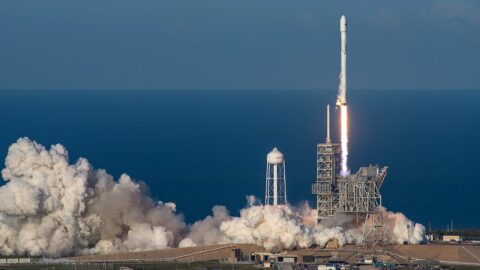
The flight hardware comes from SpaceX. The car uses cold-gas thrusters — essentially, tanks of ultra-high-pressure compressed air vented through specially designed nozzles, about ten of them, with no separate fuel required. Musk described the setup simply: “a high-pressure air tank and specially designed thrusters.” Gizmodo, citing the presentation, put the system’s thrust at roughly 80 kilonewtons.
That same air system does double duty on the ground. The rear thrusters and suction fans pin the car down so hard that it can drive inverted — the party trick that opened the show. The technology, as Musk put it, is “the results of what happens when you have a collaboration with the world’s best car company and the world’s best rocket company.”
Three versions, three prices
Tesla showed not one Roadster but three configurations. The Performance model is the road-ready two-seater with active aerodynamics and a claimed 0–60 time under 1.6 seconds. The Thrust is the race-ready two-seater with rear cold-gas thrusters, claimed under 0.9 seconds. The Rocket is the air-ready single-seater with perimeter-mounted thrusters for forward and upward acceleration plus lateral rotation — claimed 0–60 in under 0.59 seconds.
Reservations opened at $50,000 for the Performance and $250,000 for the Thrust; the Rocket is invite-only, and final prices were not announced. The claimed range is around 300 miles with a top speed above 230 mph — notably down from the original 2017 promises of 620 miles and 250+ mph. The design has been radically reworked, too: angular and Cybertruck-inspired, with an active rear wing and steer-by-wire, drawing — per Tesla’s own account — on the SR-71 and F-35.
Nine years late, and proud of it
The Roadster was first unveiled in November 2017 with production promised for 2020. Musk now says production begins in 2028. He called the car “the best of the last of the human-driven cars” and “better than any James Bond car,” and joked that retina-detaching G-forces set the upper boundary of its acceleration. After the car landed safely, he remarked: “Well, it worked.”
Asked whether the flying Roadster would be legal to drive on public roads, Musk replied: “Depends on your street.”
What remains unproven
Everything on Thursday happened under controlled conditions — reportedly in an FAA-filed no-fly zone — with no actual driver in the car, which Musk said was deliberate: “to make sure we don’t kill anyone.” The 0.81-second sprint, the thrust figures, and the 2028 production date are all company claims, and Musk’s history of missing his own timelines is well documented. Whether the car can genuinely fly rather than hop — and whether any regulator will let it do either near a public road — is entirely unresolved.
Why this matters
Flying cars have been a century-old fantasy and a graveyard of startups; a working prototype from the world’s most valuable carmaker, borrowing hardware from its rocket sibling, is genuinely new. But the Roadster’s real test was never going to be a stunt in the Texas dusk. It will be production, price, and permission — three things Tesla has not yet delivered. If Musk hits even one of them, Thursday was the night the flying car stopped being a joke. Musk’s caption on his own video of the stunt said it plainly: “Turns out the future does have flying cars.” Whether the future agrees is still an open question.
That question lands at the end of Musk’s complicated year — from a White House medal to a falling-out with Washington, in which the Tesla chief has veered between government honors and public feuds. The Roadster is his answer to all of it: look up, not back.