Amin Mia, a 26-year-old father in Bangladesh’s northeastern Sylhet region, sold his family’s three-wheeled auto rickshaw to pay for his two-year-old son Arman Hossain’s hospital treatment. The boy died unvaccinated in July, 24 hours after admission — no health workers had visited his remote village to offer vaccinations in time. “They came only after I buried my son,” he told Reuters.
His story is one of 202,000 suspected cases — 22,000 lab-confirmed — recorded since mid-March, per the World Health Organization (WHO): more than any other country in 2026. So far 1,147 people have died, 94 per cent of them children under five.
How a success story unravelled
Until recently, Bangladesh was a vaccination success story: the WHO and the United Nations children’s agency UNICEF estimated 96 per cent first-dose and 93 per cent second-dose coverage in 2024 — just short of the 95 per cent threshold that prevents outbreaks.
Then came 2024’s political upheaval, when protests ended 15 years of rule by Prime Minister Sheikh Hasina. In the turmoil, health workers went on strike, vaccine orders were delayed and routine follow-ups were disrupted. Procurement shifted away from UNICEF toward open bidding — a system UNICEF warned was unsuited to urgent needs — and Bangladesh secured only 17.8 million of its usual 70 million annual vaccine doses in 2025 (Think Global Health). A nationwide campaign planned for late 2024 was postponed, then cancelled, and a WHO-UNICEF report this July estimated 2025 coverage had fallen to 90 per cent for the first dose and 86 per cent for the second.
An emergency response that missed millions
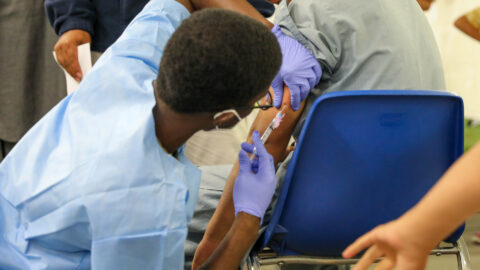
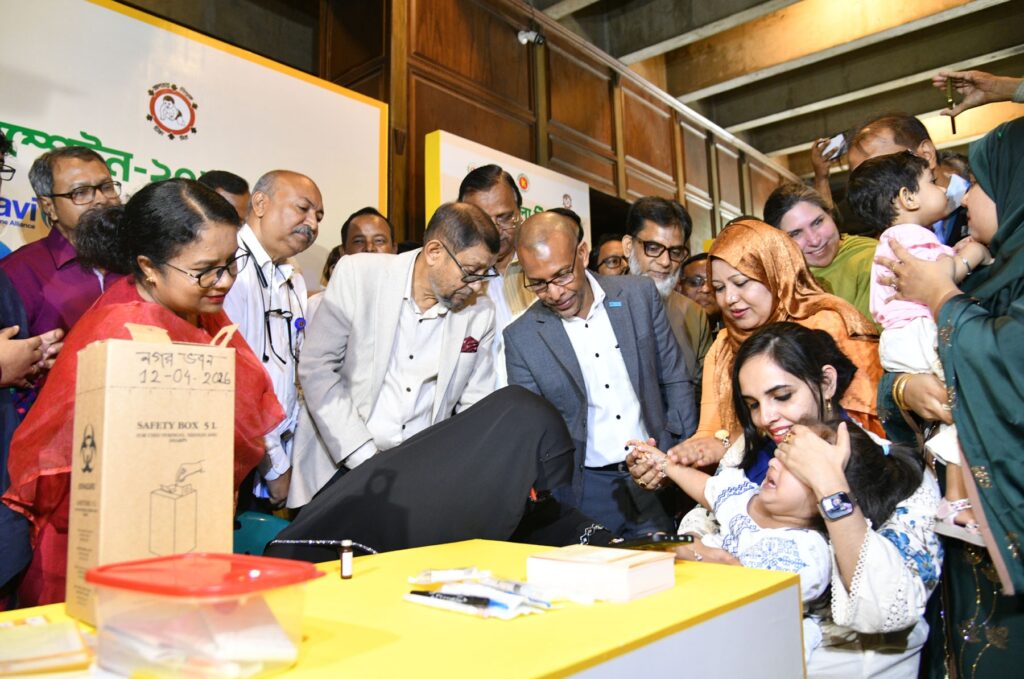
With the WHO, UNICEF and the Gavi vaccine alliance, the government began emergency vaccinations in April for children aged six months to five years across 18 high-risk districts, lowering the vaccination age from nine to six months. Nearly 20 million children were vaccinated in April and May; officials declared every child in the target age group covered.
The claim did not survive scrutiny. When another routine health programme ran in June covering the same age group, its target list held four million more children than the measles campaign’s. By an August review, the share of confirmed measles cases who had not been vaccinated was “virtually unchanged” — 82 per cent before the campaign, 85 per cent after.
Timeline: seven months of a worsening crisis
- Mid-March 2026: Bangladesh begins counting the outbreak as 100+ children die within weeks.
- April: Emergency vaccinations start in 18 high-risk districts.
- June: A parallel programme’s target list holds four million more children than the measles campaign’s — the gap is exposed.
- July: WHO-UNICEF estimates show 2025 coverage fell to 90 per cent (first dose) and 86 per cent (second).
- September: Daily cases average 1,198 — the highest since May.
- September 26: New campaign targets 3.4 million missed children; toll 1,087; 165,000+ hospitalised; the CDC calls it the world’s largest active measles outbreak.
- October 9: WHO figures: 202,000 suspected cases, about 22,000 confirmed, 1,147 dead.
The gaps the data couldn’t see
The investigation exposed structural blind spots: UNICEF and the Bangladesh Bureau of Statistics say up to 40 per cent of the country’s children go unregistered — invisible to vaccination planning — and government data showed around a third of health-worker posts unfilled. Health experts want children over five vaccinated — they account for around a third of cases per the WHO — while scientists study why maternal immunity seems to be waning faster in babies under six months.
In Sylhet, one of the worst-hit regions, official records show 180 children have died. Of 16 families Reuters interviewed there in September, eight said they had never seen health workers offering vaccinations; at least six said workers arrived only after a child had died. In Chhatak, nine-month-old Labiba Akter died unvaccinated in June, despite the lowered vaccination age. “No health worker came to tell us,” said her father, carpenter Humayun Rashid.
Why this matters beyond Bangladesh
Measles is one of the most contagious viruses known — and one of the most preventable. The WHO estimates vaccination averted nearly 59 million deaths between 2000 and 2024, yet 95,000 people, mostly young children, still died of measles in 2024. Bangladesh is the sharpest edge of a global pattern: the United States is enduring its worst measles year since 1991, with 4,080 cases — and Kenya is simultaneously fighting its first Ebola outbreak.
This is “a real warning to every country,” said Mark Jit, a WHO vaccine adviser and professor at New York University. Preventing an outbreak, he said, was easier, cheaper and safer than responding to one: “The response will stop the outbreak eventually, but in the meantime, many will have had measles, and some will have died.”
Ziauddin Hyder, special assistant on health affairs to Prime Minister Tarique Rahman, told Reuters the government was doing everything it could to end the outbreak. The government did not answer further questions sent in October.
The harder lesson, from epidemiologist Mahmudur Rahman: “When preparedness checks are not done properly, it is often the poorest and hardest-to-reach children who miss out on vaccination and pay the price.” With a concurrent dengue epidemic also stretching hospitals — Sylhet’s 100-bed measles hospital admitted 178 patients in a single September day — deputy WHO representative Dr Rajesh Narwal said: “Routine immunisation must become more effective and resilient so that these gaps do not develop again.”