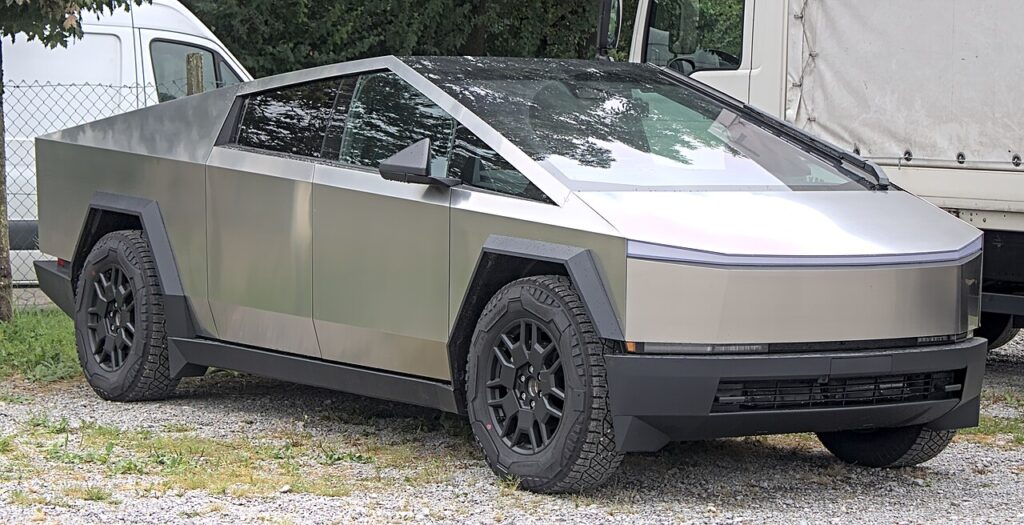
Elon Musk has called time on the Cybertruck. Tesla will wind down production of its angular stainless-steel pickup at Gigafactory Texas around the middle of 2027, the chief executive said on Friday, freeing up the factory to build more Cybercabs — the driverless robotaxi he now calls the centre of Tesla’s future.
“Tesla will be winding down production of the Cybertruck at Gigafactory Texas around the middle of next year to make room for increased Cybercab production,” Musk wrote in a short post on X on 6 November.
Musk did not say whether the truck will be built anywhere else once the Texas line stops, or whether it will be discontinued altogether. Nor did he say what will happen to outstanding orders. Austin is the only Tesla plant equipped to build the truck, whose stainless-steel body and unusual shape need specialised tooling found nowhere else in the company.
A sales flop by Tesla’s own standards
The numbers explain the decision. Tesla sold 11,586 Cybertrucks in the United States in the first nine months of 2026, down 28 percent on the same period last year, according to Kelley Blue Book data, and only 1,914 were registered in October. Deliveries in Tesla’s “Other Models” group, which includes the truck, fell to 8,295 in the third quarter from 12,364 in the second. At the truck’s unveiling in 2019, Musk had talked of selling up to 250,000 a year.
The Cybertruck never came close to the price Musk promised either. Unveiled at $39,900 — a figure that became famous when its supposedly unbreakable windows cracked on stage — the cheapest version on sale today is a dual-motor model launched in February 2026 at $59,990. Hours before Musk’s announcement, Tesla raised US Cybertruck prices by up to 9 percent and paused new orders for that cheapest trim, leaving only the Premium and Cyberbeast versions available to order.
It was also a troubled vehicle. The US National Highway Traffic Safety Administration has recorded 11 recalls since the truck went on sale in late 2023, the latest in April 2026 covering 173 trucks whose brake-rotor stud holes could crack and let a wheel stud separate from the hub. No crashes or injuries were linked to that fault. In October, Tesla cancelled plans to sell the truck in Australia and New Zealand altogether and refunded reservation holders, because the truck was never built in right-hand drive.
What happens to owners
Musk moved quickly to reassure existing owners. Replying on X to a user who called the Cybertruck “the best vehicle Tesla has ever made”, he wrote: “True, but the Cybertruck fleet will be around for a long time.” Wes Morrill, the truck’s lead engineer, said existing vehicles would keep parts and service support, and called the Cybertruck “an incredible technology development platform” that “lives on through Cybercab”.
The robotaxi bet
The vehicle taking the Cybertruck’s place on the Austin factory floor is the Cybercab, a two-seat robotaxi with butterfly doors and no steering wheel, pedals or mirrors, unveiled in October 2024. Production began earlier this year, and about 570 of the more than 1,200 Tesla robotaxis operating in Texas are already Cybercabs, according to the state’s Department of Motor Vehicles. Tesla aims to start selling the Cybercab to the public by the end of the year, and Musk has said he expects eventually to build more Cybercabs than all of Tesla’s other vehicles combined.
It is a large bet on a vehicle that has yet to prove itself. US safety regulators have opened an audit query into Tesla’s certification that the Cybercab meets federal motor vehicle safety standards, and the robotaxi programme is still small next to the millions of cars Tesla sells each year.
Why it matters
The Cybertruck was Musk’s most personal project — a vehicle he designed to look like the future and defended as a statement of intent. Its end marks Tesla’s clearest shift yet from carmaker to autonomy company: the factory floor that built the pickup will now build cars with no driver at all. The announcement caps a noisy few weeks for Tesla, whose flying Roadster stunt drew the same mix of awe and mockery in October.
For the wider car industry, the lesson is sobering. The Cybertruck showed that a famous name and a radical design are not enough — electric pickups live or die on price, reliability and battery economics, which hinge on lithium, the metal at the heart of every electric vehicle. Legacy truck makers watching Tesla’s retreat will take note: the electric pickup market is still waiting for its breakthrough vehicle, and it will not be this one.